





As I write this, there are three book ban bills working their way through the House and Senate: H.R. 8705, H.R.2616, and H.R.7661. By the time you read this, who knows where these bills will be or what fresh hells are coming down the pike. There’s a good chance book bans are happening in your community. These aren’t grassroots movements but highly-funded and organized campaigns designed to push queer people back into the closet and chain the door shut. Traditional publishing was already a difficult hill to climb for marginalized authors writing diverse characters. With the increase in bigots banning and challenging books, publishers and agents are rejecting queer books at staggering rates; soft censorship by librarians and booksellers is also on the rise.
Defending the right to read may feel overwhelming, but there are lots of actions you can take right now in your community. If you haven’t contacted your political representatives yet about whatever awful book ban bills are happening when you read this, consider this your sign to pick up your phone. Kids deserve to see themselves and each other reflected in literature. They deserve respect and to feel seen as who they truly are. Authors, publishers, and other book industry folks are on the frontlines, and we need you, yes you, to join us. Whether queer or an ally, we all need to take a stand. You have more power than you realize. Pride isn’t just a celebration, it’s a revolution and a riot. Pick up your wallet, your phone, and a brick and get to it.
Ash by Malinda Lo
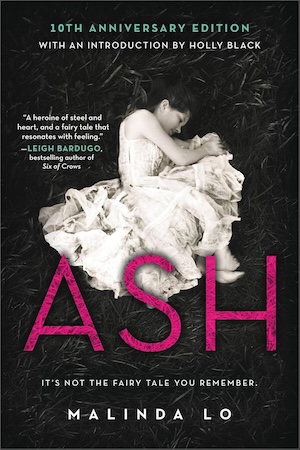
(Ash #1 — Little, Brown Books for Young Readers, 2009) Authors like Malinda Lo helped kick the door open for queer YA. Much of the older queer YA was written by cisallohet people who often struggled (and even more often failed) at accurate or respectful representation. It was rare to get queer YA written by a queer author, especially a queer author of color. This “Cinderella”-inspired fairy tale has more in common with the Brothers Grimm than Disney. After losing both her parents, Ash is trapped in a house with her cruel stepmother and stepsisters. The fairy Sidhean offers her a way out, and it leads her into the arms of Kaisa, the King’s Huntress. The fairies offer her a deal she soon regrets, and she may lose Kaisa forever.
Blanca & Roja by Anna-Marie McLemore
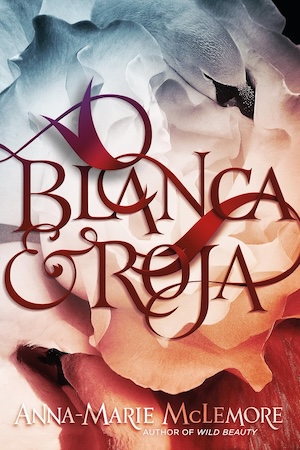
(Feiwel & Friends, 2018) Partially a Latinx and queer remix of “Snow White,” “Rose Red,” and “Swan Lake,” this beautiful book explores the complicated relationships of a quartet of teens. The del Cisne sisters Blanca and Roja couldn’t be more different. One day the swans will come to claim one of them as their own, transforming her body against her will. When a local teen, Yearling, goes missing in the woods and his friend, Page, chases after him, they get pulled into the sisters’ orbit. I read this book for a Reactor review back in 2018. It was the first of Anna-Marie McLemore’s books I’d ever read, but certainly not the last. This was the story that helped me realize I was genderqueer. I’d been questioning my gender for a few years by that point; I knew what I wasn’t, but I didn’t know what I was. McLemore’s examination of the nuances of gender beyond the binary opened my eyes to the possibilities. They helped me see that, like with asexuality and aromanticism, I could define “nonbinary” however I wanted, that it wasn’t a third gender that was halfway between the binary poles but something more vast and uncategorizable and wholly unique to each of us under that umbrella.
The Art of Saving the World by Corinne Duyvis
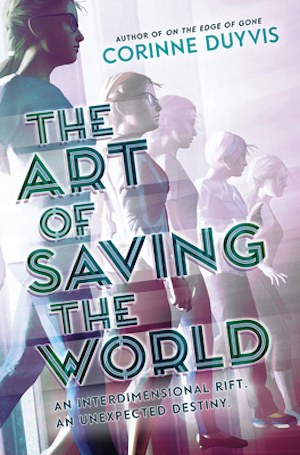
(Amulet Books, 2020) There aren’t a lot of YA books with asexual and/or aromantic spectrums, especially not at the current moment when romantasy and romantic subplots dominate young adult speculative fiction. This book from 2020 is a must-read for ace rep. For some inexplicable reason, sixteen-year-old Hazel is connected to a rift that threatens to destroy the world. With the help of several Hazels from other dimensions—all of whom are in varying stages of discovering and coming out about their asexual lesbian flavor of queerness or dealing with mental health and chronic illness—Hazel Prime will try to save the world… and herself.
Ruinsong by Julia Ember
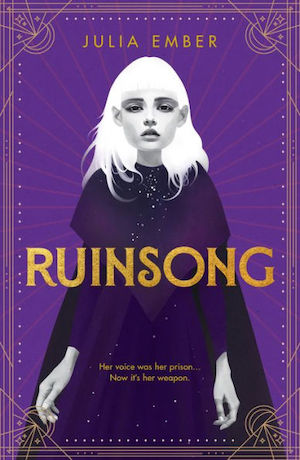
(Farrar, Straus and Giroux Books for Young Readers, 2020) Cadence is a singer with magical powers caught in the clutches of the wicked Queen Elene. Every year for the Performing, she sings a song that torments the nobles that survived Elene’s bloody purge. After the latest Performing, Cadence’s childhood friend Remi is brought back into her orbit. As rebellion simmers just under the surface, the girls fall in love. Soon they’ll have to decide what they’ll risk to stay together. Besides being a great novel, I think this book is particularly relevant for this moment in time because of its villain. Queen Elene came into power after a political coup and quickly filled the palace with toadies and sycophants. She delights in weaponizing her power over others and in crushing any opposition. She is entitled, callous, and dismissive. Obey or be destroyed. In other words, cruelty is the point. And yet, our queer protagonists keep fighting.
Infinity Alchemist by Kacen Callender
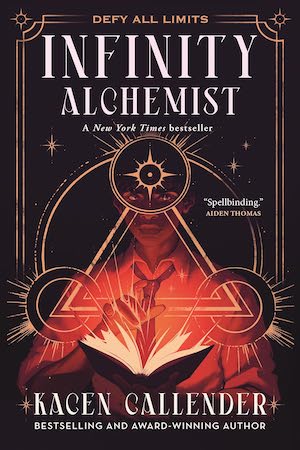
(Infinity Alchemist #1 — Tor Teen, 2024) There is very little YA fiction with a trans masc main character, and even fewer where the character is BIPOC. You can count the traditionally published trans masc authors of color writing ownvoices YA speculative fiction books on two hands and still have fingers left over. That makes Callender’s very fun and very queer Infinity Alchemist series even more worth reading. With a teen cast all over the queer spectrum, readers get to see identities that don’t get much representation in traditional publishing. Ash is so determined to learn alchemy even after being rejected by a magic school that he makes a deal with haughty Ramsey to find a powerful artifact. Gender goes on a wild ride in this book, as does the plot. This isn’t your average dark academia romantasy.

